Sample Inquiry-Based Lesson Plan

Title
The Effect of Density on the Waters of the Rio Negro and the Rio Solimões.
Course Level
9th grade (middle school).
Number of Students
Three classes (9A, 9B and 9E).
Class Time
Two consecutive Mondays, with a double period (2 × 45 minutes) each day: about 3 hours in total per class.
Lesson Plan Description
This unit asks a question that students can see on a map and in photographs: why don’t the waters of the Rio Negro and the Rio Solimões mix when the two rivers meet to form the Amazon River? Students investigate the question through a guided reading, a hands-on experiment on temperature, and a demonstration on the effect of dissolved solutes, and then connect what they observed to the density of water.
Context
This lesson plan was designed as part of the Supervised Teaching Internship in Biology Education (first semester of 2016), a field-based course of my Biology Education (Licenciatura) degree at the University of São Paulo (USP), in which student teachers plan and teach an intervention in a real school classroom. I developed it together with Lara Machado de Azevedo, and we taught it to three 9th-grade classes at a municipal middle school, in collaboration with the classroom science teacher. She offered three possible topics for the intervention (density, solubility, or separation of mixtures), and we chose density, connecting it to the Meeting of the Waters, a phenomenon that students can investigate with simple materials.
The course was led by university professors with the support of teaching assistants, and it required a written plan covering the theme, the objectives, the class-by-class sequence, the content and the assessment.
Learning Goals
By the end of this unit, students will be able to:
- Deepen their knowledge of density by identifying two variables that affect this physical property in the same substance (temperature and type of solute).
- Make predictions and interpret their observations about the effect of temperature and type of solute on the density of substances.
- Relate the observations from the experiments to the phenomenon that occurs at the meeting of the waters of the Rio Negro and the Rio Solimões.
Lesson Sequence
Day 1
1. Introduction and guided reading (about 45 minutes). We presented the sequence of activities and the central question, “Why don’t the waters of the Rio Negro and the Rio Solimões mix?” Students read a text we wrote about the two rivers (Handout A) and individually answered four comprehension questions, ending with their own hypotheses for the phenomenon.
2. Temperature experiment (about 45 minutes). In groups of about four, students first predicted whether temperature affects the density of water. They then used a plastic bottle half-filled with room-temperature water, to which they added a blue-colored ice cube and hot water colored red. Students observed that the hot water stayed on top while the cold blue water sank as the ice melted, and answered written questions about their observations, their initial prediction, the effect of temperature on mixing, and its likely cause.
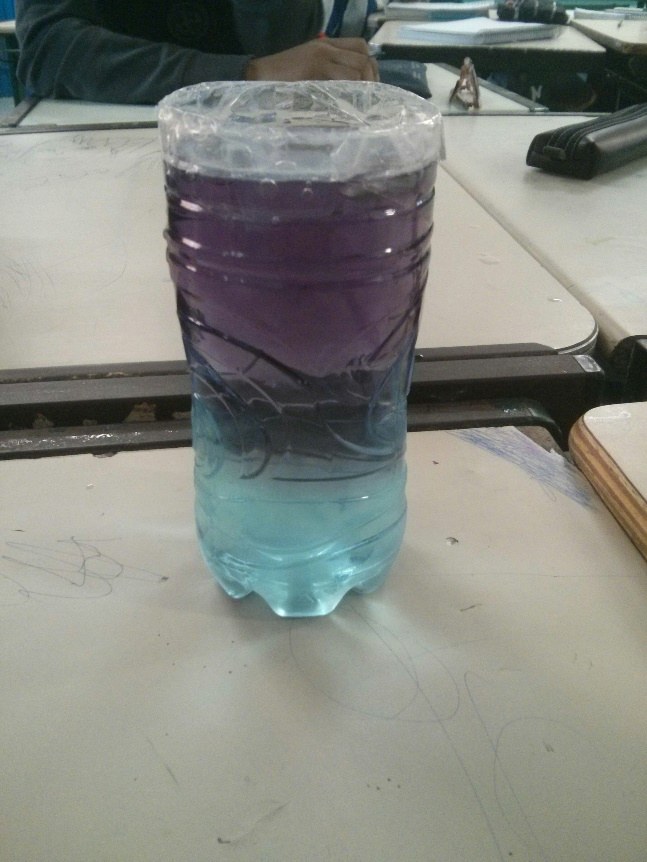
Figure 1. An example of a successful temperature experiment: the hot water stayed in the upper part of the bottle, while the cold water (released as the ice melted) stayed in the lower part.
Day 2 (one week later)
3. Demonstration on the type of solute (about 45 minutes). Students wrote their predictions, observations and explanations at each step of the demonstration (Handout B).
We prepared a 15-liter aquarium lined in the middle with sealing rubber, so that a piece of glass could be slid in and out and work as a movable barrier.
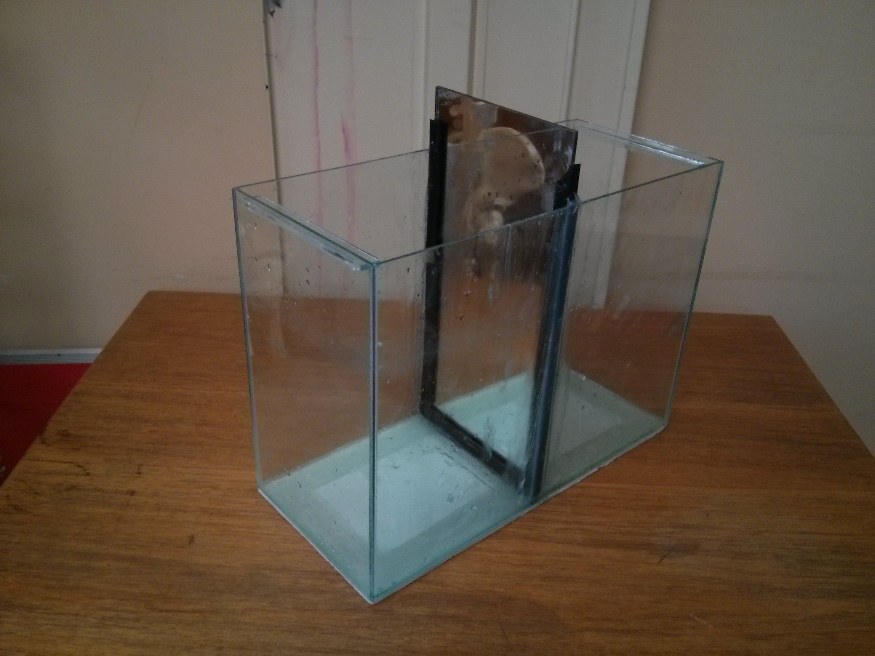
Figure 2. The aquarium prepared for the investigation of the effect of solute type on the density of water. The 15-liter aquarium was lined with 5 mm sealing rubber in the middle, fixed with silicone, and a piece cut to size served as the movable barrier.
The aquarium was filled with 9 liters of tap water. Sugar and red dye were added to one side, and salt and blue dye to the other. Students predicted what would happen when the barrier was removed.
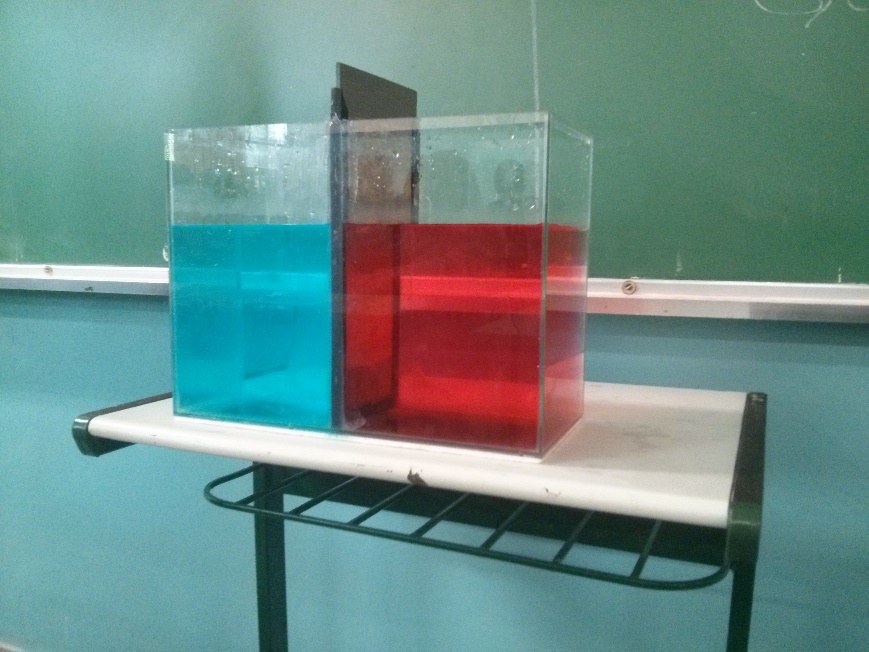
Figure 3. The aquarium filled with 9 liters of water before the barrier was inserted. Five spoonfuls of salt and blue dye were added to the left side, and five spoonfuls of sugar and red dye to the right.
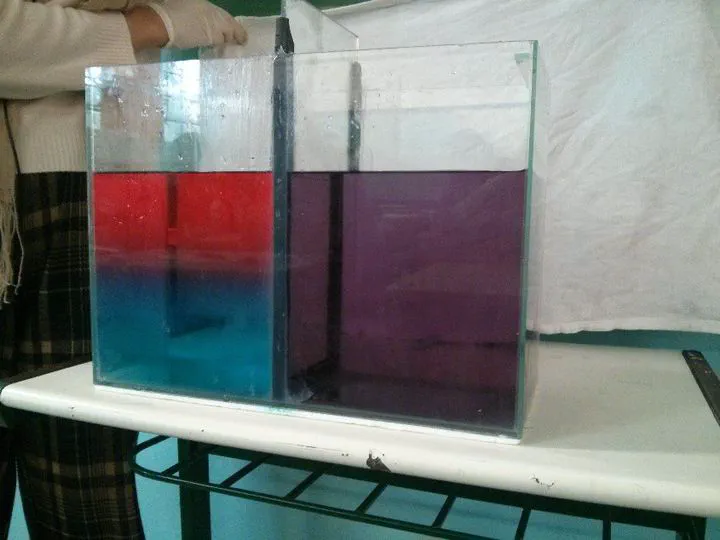
When the barrier was removed, the waters did not mix: the denser, salt-rich blue water settled in the lower part of the aquarium and the sugar-rich red water stayed in the upper part.
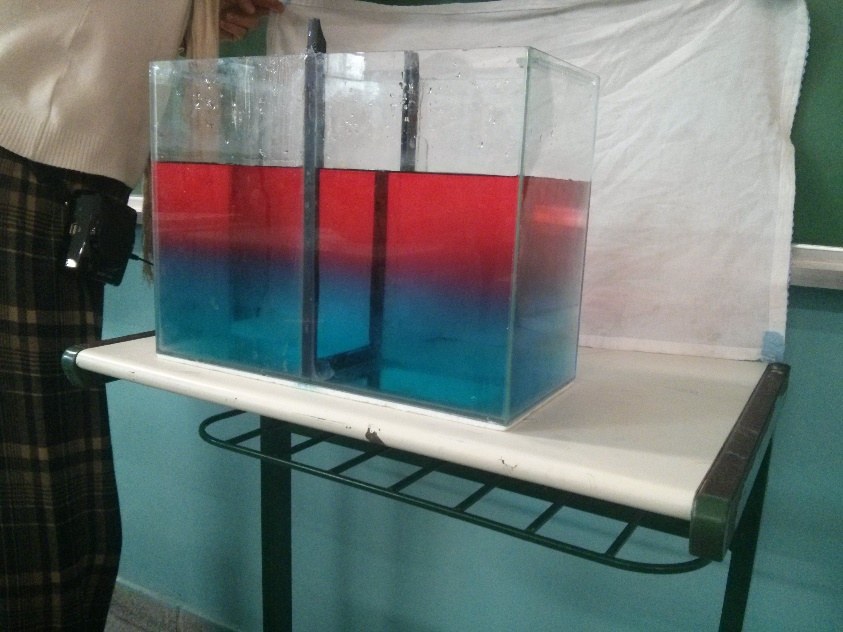
Figure 4. After the barrier was removed, the salt-rich water occupied the lower part of the aquarium, while the sugar-rich water stayed in the upper part.
The barrier was then reinserted, and students answered whether they believed the waters could be mixed actively. One side was stirred with a spoon, and the water turned purple, showing that the solutions can be mixed.
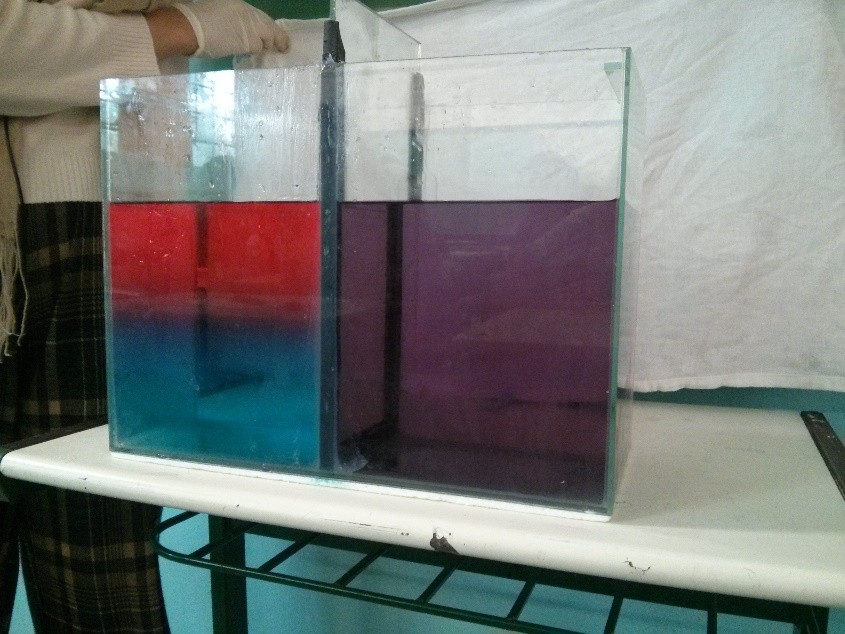
Figure 5. The barrier was reinserted and the water on the right side of the aquarium was actively mixed with a spoon. The purple color shows that the solutions were miscible.
Students predicted again what would happen when the barrier was removed, and then observed the purple water settle between the blue and red layers.
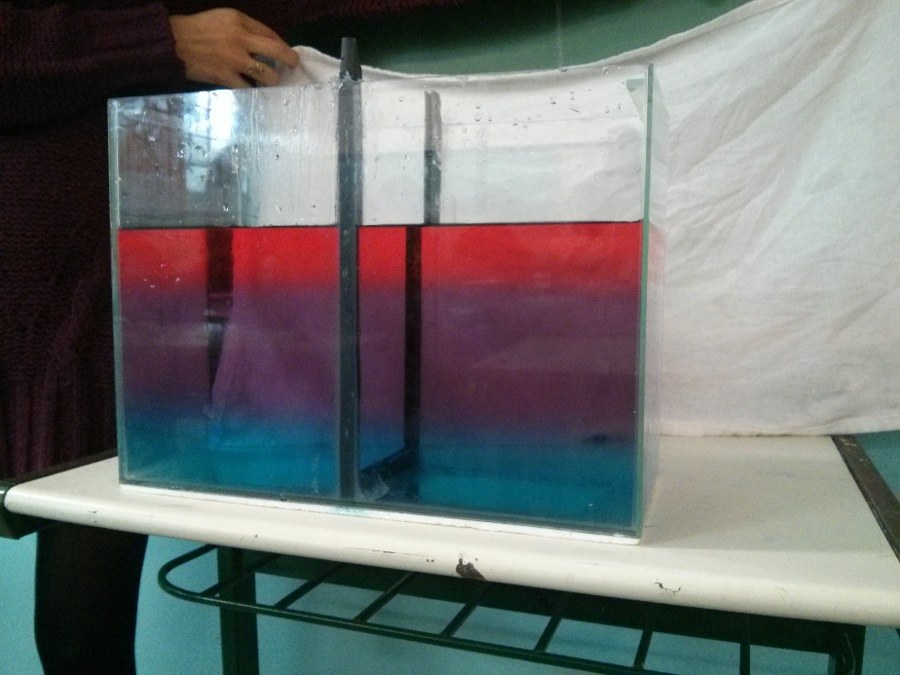
Figure 6. After the barrier was removed, the purple water occupied the central part of the aquarium, since its density was intermediate between that of the original waters.
4. Discussion and conclusion (about 30 minutes). We led a class discussion to recall the differences between the two rivers and the results of both experiments, and to help students move from hands-on actions to intellectual ones. The ideas students mentioned were organized on the board. Finally, each student answered the central question in writing, relating the results of the two experiments to the reading.
Frameworks
The activities follow the phases of inquiry-based learning described by Pedaste et al. (2015): orientation (guided reading), investigation (temperature experiment and demonstration), discussion, and conclusion. Both experimental activities are at level 2, structured inquiry, of the levels of inquiry described by Banchi and Bell (2008).
Assessment
Learning was assessed from the individual written responses, using a scoring guide for each activity (10 points each):
- Reading comprehension: locating the source of each river (1 point each), where the rivers meet (2), identifying the three variables that differ between the waters (3), and formulating a coherent hypothesis (3).
- Temperature experiment: a coherent initial prediction, whether or not it was correct (2), a description of the observations (2), a comparison of the observations with the prediction (2), recognizing that temperature affects mixing (2), and associating the results with a change in density (2).
- Demonstration: an appropriate initial answer (1), a description of the observations (1), coherent predictions before each barrier removal (1.5 each), a comparison of each prediction with the result (2 each), and a response about whether the waters could be mixed actively (1).
- Final written conclusion: responses were reviewed for whether students understood density, how temperature and type of solute affect it, and how these ideas explain why the two rivers do not mix. One of the strongest responses was: “Because they have different densities, which are affected by their substances and temperatures.”